IP Location

Cable Networks

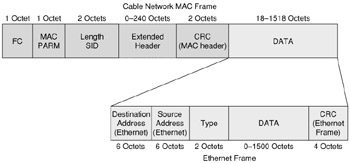
Cable television dates back to the late 1940s and stems from the problem of some areas receiving only weak televisions signals. To counter this, communities established common antennas in good areas of reception and ran cables past households allowing them to obtain a strong clear signal. This scheme was called Community Antenna Television or CATV, a name that is still used today to describe cable television and data deployments. The North American cable industry formed an alliance in 1995 to develop specifications for data over cable networks called Data Over Cable Service Interface Specifications (DOCSIS), and it is these DOCSIS-based networks that are currently the heart of modern cable networks in North America. This section provides a brief overview of cable networks as they relate to DOCSIS-based deployments. The details of framing and network registration, as well as authentication, are not considered.

The Anatomy of Cable Networks

Cable networks have come a long way since the basic concept of a shared antenna. The general principle and architecture of cable networks is that first and foremost they are broadcast networks, with signals being sent from a single headend to a multitude of receivers in people's houses. Data signals in cable networks are carried in channels where each channel is allocated a band of spectrum within the cable's total available bandwidth. Channels in the United States generally have a bandwidth of 6MHz the basic channel bandwidth adopted into the DOCSIS suite of specifications (see Figure 6.25).


Figure 6.25: A modern cable...

UNLIMITED FREE
ACCESS
TO THE WORLD'S BEST IDEAS

SUBMIT
Already a GlobalSpec user? Log in.

This is embarrasing...

An error occurred while processing the form. Please try again in a few minutes.

Customize Your GlobalSpec Experience

Category: RF Headends
Finish!
Privacy Policy

This is embarrasing...

An error occurred while processing the form. Please try again in a few minutes.