Maintenance of Process Instrumentation in Nuclear Power Plants

The response time of a temperature sensor depends on installation and process conditions. In particular, the process temperature and flow have a significant influence on response time. The effect of flow is generally predictable, but the effect of temperature is not. That is, increasing the flow decreases the response time, but increasing the temperature can cause an increase or a decrease in response time, depending on how temperature affects the material properties and heat transfer inside the sensor. For thermowell-mounted sensors, the response time depends largely on the fit between the measuring tip of the sensor and its thermowell. This effect dominates the response time of thermowell-mounted sensors. That is, any sensor/thermowell mismatch can make a large difference in the sensor response time. As such, the response time of a thermowell-mounted sensor must be measured with the sensor installed in the thermowell in which the sensor is used.
The LCSR method was developed in the mid-1970s to measure the "in-service" response time of nuclear plant temperature sensors. The method takes into account the effects both of installation and process conditions on response time. It is used routinely in nuclear power plants and is currently the only method that has received formal approval from the U.S. NRC.
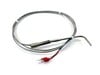
As for thermocouples, the LCSR method is also well developed but not formally reviewed or approved by a regulatory body. This is mainly because nuclear plant thermocouples are not currently subject to any stringent response-time performance requirements. Thermocouples are, however, tested for...