Masonry and Concrete: For Residential Construction

Mortar is the cementitious material that bonds units, connectors, and reinforcement together for strength and weather resistance. Although it contributes to the compressive strength of the masonry, mortar s primary functions are in providing bond strength and in sealing the joints between units against the passage of air and water. To perform these functions, it must be properly mixed and placed to achieve intimate contact with the unit surface and form both a mechanical and chemical interlock.
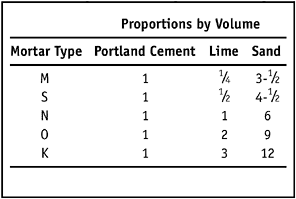
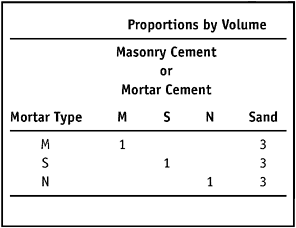
Mortar mixes must be carefully controlled at the job site to maintain consistency in performance and appearance. Consistent measurement of mortar ingredients should ensure uniformity of proportions, yields, strengths, workability, and mortar color from batch to batch. Volume rather than weight proportioning is most often used because it is simpler. Ingredient proportions for the various types of conventional mixes are shown in Figures 5-12 and 5-13. Portland cement, mason s lime, and masonry cement are packaged and labeled only by weight. Each bag of portland cement or masonry cement equals one cu. ft. regardless of its labeled weight, and each bag of hydrated mason s lime equals 1-1/4 cu. ft. regardless of its weight. Cement and lime are generally charged into the mixer in whole or half bags, depending on the mixer size and the batch size needed.