Masonry Design and Detailing for Architects and Contractors, Fifth Edition
Featuring insight on the complete range of masonry topics, this hands-on guide provides hundreds of illustrations to maximize your understanding of these critical issues.
 TABLE OF CONTENTS
 Clay as a raw material is most valued for its ceramic characteristics. When subjected to high firing temperatures, the silicates in clay melt, fusing the particles to a density that approaches vitrification. The resulting strength and weather resistance make brick, structural clay tile, and terra cotta among the most durable of building materials.
There are many different shapes, sizes, and types of brick. ASTM standards cover building brick, facing brick, hollow brick, paving brick, firebox brick, glazed brick, chemical resistant brick, and others based on appearance of the unit. The three most widely used are building brick, face brick, and hollow brick ( see Fig. 3-1).
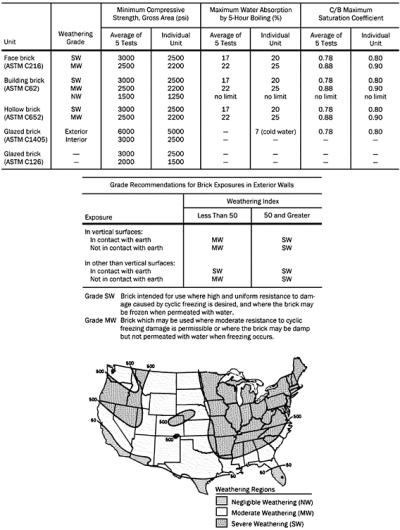
Building brick (sometimes called common brick) is used primarily as a structural material or as a backing for other finishes, where strength and durability are of more importance than appearance. Under ASTM C62, Standard Specification for Building Brick, grading is based on physical requirements and directly related to durability and resistance to weathering ( see Fig. 3-2).
| Brick Grades for Durability | |
|---|---|
| Grade SW | brick for use where high and uniform resistance to damage caused by cyclic freezing is desired, and where brick may be frozen when saturated with water |
| Grade MW |