Masonry Design and Detailing for Architects and Contractors, Fifth Edition
Featuring insight on the complete range of masonry topics, this hands-on guide provides hundreds of illustrations to maximize your understanding of these critical issues.
 TABLE OF CONTENTS
 The quality, durability, and cost effectiveness of masonry systems are affected by decisions made throughout the design and documentation phases, and by field observation and inspection practices. Project specifications establish standards of quality, which should be strictly enforced to ensure structural integrity, weather resistance, and long service.
Exterior envelope materials are usually selected on the basis of both cost and aesthetics. An architect or building owner may begin with a mental image of the project that is related to its context, its corporate identity, and its budget. Masonry is very cost-competitive as an envelope material, but the decision to use masonry of one type or another is usually an aesthetic one. Material selections are based on color, texture, and scale.
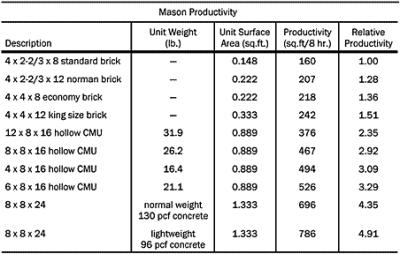
The relative cost of different types of brick or different types of architectural block is related primarily to unit size and labor production. Typical union production rates for several types of brick and block are listed in Fig. 18-1. Within a selected size, however, aesthetic preference should govern unit selections, because the cost of materials has only a small effect on the cost of the completed envelope. According to one study, doubling the cost of brick added less than $2.00/sq ft to the wall cost. There are a number of other design and specification decisions that affect masonry cost and can be used to minimize budget limitations.