Mass Spectrometry for Chemists and Biochemists, Second Edition

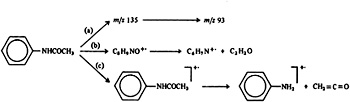
In interpreting a mass spectrum it is convenient to postulate ion structures to explain the observed fragmentation pathways. Generally, the actual structures of ions in a mass spectrometer are not known, although the elemental compositions may be, and hence there is a need to postulate structures. If the compound investigated has a known structure, the mass spectrum is often interpreted by assuming a minimum of structural change at each fragmentation step. To illustrate this point, part of the fragmentation of acetanilide may be considered in three alternative ways (scheme (10.2a, b, c)). The first way (a) shows ionization and fragmentation in terms of m/z values and gives
| (10.2) | ![]() |
little information, but it is verifiable. The second (b) gives the same pathway in terms of elemental compositions of the ions; this affords much more information since the compositions of the ions and of the unit lost at the fragmentation step are known. Assuming that accurate mass measurements have been completed, this depiction represents experimental fact. The third way (c) adds postulate to experimental fact by assuming or postulating the structures of the molecular and fragment ions as well as the neutral species to be as shown, i.e. with minimum change from the original molecule. It is not a straightforward task to confirm these ionic structures. They may or may not be correct, but this is quite immaterial to the convenience of describing fragmentation pathways in this way.
An added advantage of postulation...