Mathematical Modeling of Physical Systems: An Introduction

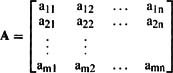
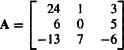
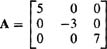
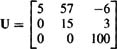
We start this section with the definition of a matrix and a description of some important special matrices. These are summarized for convenience in Table 2.2.
|
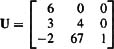
The matrix itself is an array of entries, usually numerical, which are arranged in m rows and n columns (see item 1 of Table 2.2). Among the special matrices we note the square matrix (item 2) with m = n, and the diagonal matrix (item 3), which is a square matrix with nonzero entries confined to the diagonal. When these entries are all unity, the array becomes the identity matrix (item 6). Upper and lower triangular matrices (items 4 and 5) are square matrices that have zero entries respectively below and above the diagonal. Finally we note two one-dimensional versions of the general matrix that take the form of column and row vectors (items 8 and 9). Although the examples given in the Table 2.2 are all 3 3 matrices for reasons of convenience, the order of the matrix can in principle comprise any number of rows and columns. Further, the entries are not confined to integers, as was done here for brevity; an entry can be any positive or negative fraction or integer, including of course zero. Matrices with imaginary or complex entries also exist but are...