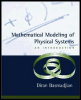
Mathematical Modeling of Physical Systems: An Introduction
Practice Problems

1.

Properties of vectors

  1. Can a scalar product be negative?

  2. If A B = A C, does it necessarily follow that B equals C?

  3. If A B = 0, must A and B be parallel to each other? Is the converse true?

  4. If three vectors add up to zero, they must all be in the same plane. Make this plausible.

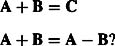
  5. What are the properties of two vectors A and B such that


2.

Distance of a point from a line Consider a line defined by the two points A(2, 3, 0) and B( ?1, 2, 4). Find the shortest distance d to this line from a point P with the coordinates (3, 1, ?1). ( Hint: Show that ).

3.

Torque: Balancing a teeter-totter If a force F acts on a body at a point P, which is located by the position vector R, then the torque ? acting on the body with respect to the origin 0 is defined as


with a magnitude ? of


we apply the relation (1) to Newton's law


and obtain, by cross-multiplying each side by the position vector R and summing over all forces,


For a static system at equilibrium, a = 0, and we obtain


That is, the sum of the torques acting on a static body must equal zero. This is sometimes referred to...

UNLIMITED FREE
ACCESS
TO THE WORLD'S BEST IDEAS

SUBMIT
Already a GlobalSpec user? Log in.

This is embarrasing...

An error occurred while processing the form. Please try again in a few minutes.

Customize Your GlobalSpec Experience

Category: Air Cylinders
Finish!
Privacy Policy

This is embarrasing...

An error occurred while processing the form. Please try again in a few minutes.