Mechanical Assemblies: Their Design, Manufacture, and Role in Product Development

4.J. PROBLEMS AND THOUGHT QUESTIONS

4.J. PROBLEMS AND THOUGHT QUESTIONS

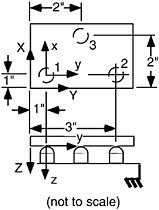
  1. Prove that three points define a plane using three hemispherical features touching a plate, as shown in Figure 4-39.


    Figure 4-39: Figure for Problem 1.

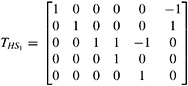
    Hint: The twist matrix for the plate resting on hemisphere number 1, referred to the lower left corner of the plate, is

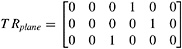
    Write down the twist matrices for the plate resting on each of the other two hemispheres, then combine the three twist matrices according to the twist matrix intersection algorithm in Section 4.E.2.d.2. You should get (give or take some minus signs that are not significant)

    This says, row by row, that the plate can slide in the X direction, it can slide in the Y direction, and it can rotate about Z. This is consistent with the properties of a plane.

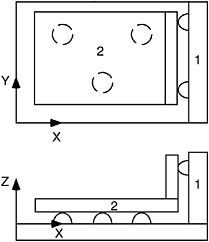
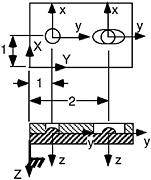
  2. Figure 4-40 shows an arrangement in which part 1 has three hemispherical features under part 2 and two such features at its right. Prove that this configuration leaves part 2 with exactly one unconstrained degree of freedom relative to part 1. Confirm that the result makes sense in terms of the coordinates shown in Figure 4-40.


    Figure 4-40: Figure for Problem 2.

  3. Use toolkit features 9, 18, and 19 to analyze the situation shown in Figure 4-41. Follow the methodology in Section 4.F.4.a.


    Figure 4-41: Figure for Problem 3.

    You should be able to show that the upper plate cannot move and it is not overconstrained.

  4. Consider the part pair in Figure 4-42,...

UNLIMITED FREE
ACCESS
TO THE WORLD'S BEST IDEAS

SUBMIT
Already a GlobalSpec user? Log in.

This is embarrasing...

An error occurred while processing the form. Please try again in a few minutes.

Customize Your GlobalSpec Experience

Category: Specialty Rotary Bearings
Finish!
Privacy Policy

This is embarrasing...

An error occurred while processing the form. Please try again in a few minutes.