Mechanical Assemblies: Their Design, Manufacture, and Role in Product Development

Mating one pin and socket isn t so hard. Mating 100 at once can require a hydraulic jack.
Chapter 10 dealt with compliantly supported rigid parts entering rigid holes. It was shown that insertion force and two different failure modes depended on three basic factors: geometry, compliance, and friction. The main design parameter at our disposal was shown to be the location of the compliance center of the rigid part s support.
Different problems and design opportunities arise when at least one mating part is compliant. In particular, we shall see in this chapter that the shape of at least one mating surface can be varied so as to greatly affect the mating force. [1] The first part of the chapter presents analytical models for the main physical phenomena. The second part develops those models for several general cases. The third part focuses specifically on opportunities for designing mating surfaces, while the last part presents experimental verifications of the theory.
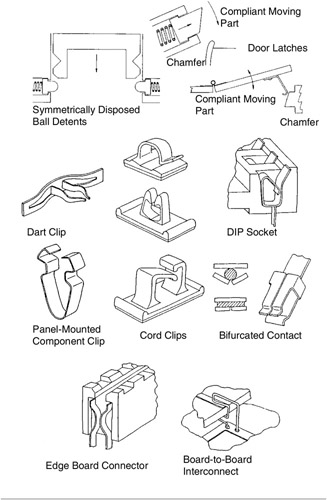
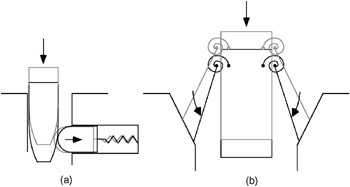
Figure 11-1 exhibits numerous applications of compliant parts, including electric connectors, door latches, snap fits, and light bulb sockets. Figure 11-2 shows two simplified geometries that contain the elements considered in this chapter. Compliant sheet metal parts are not treated in this chapter.