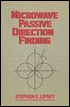
Microwave Passive Direction Finding

Chapter 11: Future Trends

OVERVIEW

Microwave passive direction finding has been presented here in many different forms and many different ways. As originally stated, the purpose of this book has been to trace both the development of direction finding from its origins and to explain and describe the means of the technology to permit interested engineers to find the methods of the technique in one place. Any book covering as many aspects as I have tried to do undoubtedly raises questions. Some can be answered by more research, some by intensive study of the references, some only by the future acting as a driving force.

The rapid development of solid-state devices capable of developing RF energy at high microwave frequencies has resulted in small, high-gain, active transmitting and RF receiving antenna array systems. These arrays will permit high-effective radiated power to be generated by multiple aperture antennas, which will require high-accuracy, steered-beam receivers for seton. Such systems presently exist and are becoming deployed in many new applications. Small size is a natural fallout, and it is reasonable to expect printed circuit RF techniques to become more prevalent for both the circuitry and radiating elements. Evidence of this trend is clear in present literature, with the strong emphasis on microstrip and "patch" antenna technology. Adaptive array systems are also being developed to optimize these concepts.

Passive DF accuracy has become an important targeting or aiming tool, forcing DF accuracy to be improved. These accuracy trends for future radar warning or ESM systems place emphasis on...

UNLIMITED FREE
ACCESS
TO THE WORLD'S BEST IDEAS

SUBMIT
Already a GlobalSpec user? Log in.

This is embarrasing...

An error occurred while processing the form. Please try again in a few minutes.

Customize Your GlobalSpec Experience

Category: RFID Tags
Finish!
Privacy Policy

This is embarrasing...

An error occurred while processing the form. Please try again in a few minutes.