MIG Welding Guide
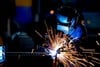
MIG (metal inert gas) welding, also known as gas metal arc welding (GMAW), is a key joining technology in manufacturing. This book provides a comprehensive, practical and accessible guide to this widely used process.
 TABLE OF CONTENTS
K WEMAN, Wemab AB, Sweden
Gas metal arc welding (GMAW) also called MIG (metal inert gas) if the shielding gas is inert, for example argon, or MAG (metal active gas) if the gas has a content of an active gas such as CO 2. In Europe the process is usually called MIG/MAG or just MIG welding.
The process is used in a wide range of plate thicknesses even though it has been most dominant in thin sheet welding. This is because of its easiness in starting and stopping and thereby its relatively high productivity. Compared to stick electrode (MMA) welding there is no need for the frequent electrode changes and slag removal.
The principle of MIG welding is that a metallic wire is fed through the welding gun and melted in an arc. The wire serves the dual purpose of acting as the current-carrying electrode and as the weld metal filler wire. Electrical energy for the arc is supplied by a welding power source. The arc and the pool of molten material are protected by a shielding gas, which is either inert or active. In this context, an inert gas is one that does not react with the molten material. Examples of gases in this...