MIMO Wireless Communications

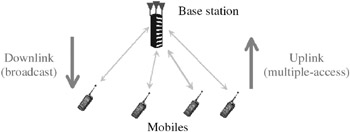
In this section we give capacity results for the two basic multi-user MIMO channel models: the MIMO multiple-access channel (MAC or uplink) and the MIMO broadcast channel (BC or downlink). The MIMO MAC consists of many multiple-antenna transmitters sending to a single multiple-antenna receiver and the MIMO BC consists of one multiple-antenna transmitter sending to many multiple-antenna receivers. In cellular-type architectures (e.g. cellular networks or wireless local-area networks), the MAC models the channel from mobile devices to the base-station, and the BC models the channel from the base-station to mobile devices. The uplink and downlink channels are illustrated in Figure 2.9. As discussed in Section 1.4 multiple antennas are becoming increasingly common in such systems (e.g. in IEEE 802.11n or IEEE 802.16), and thus it is important to understand the fundamental limits of such channels. Multi-user MIMO receivers are significantly more complex than single-user MIMO systems, since the signals from all users must be detected simultaneously. Practical techniques for multi-user MIMO detection are described in Chapter 6.
The channel capacity of a point-to-point MIMO channel is a real number which is the fundamental limit on reliable communication: any rate strictly smaller than the capacity is achievable, while all rates strictly larger than the capacity are not achievable. For multi-user channels, the channel capacity has a similar definition, but the capacity is a region (i.e. a set in K-dimensional space) instead of a single number because different rates...