Chapter List
- Chapter 6: Introduction
- Chapter 7: Getting Started
- Chapter 8: Scicos Formalism
- Chapter 9: Scicos Blocks
- Chapter 10: Examples
- Chapter 11: Batch Processing in Scilab
- Chapter 12: Code Generation
- Chapter 13: Debugging
- Chapter 14: Implicit Scicos and Modelica
Scicos is a Scilab toolbox for modeling and simulation of dynamical systems. Scicos is particularly useful for modeling systems where continuous-time and discrete-time components are interconnected. Such models can be programmed directly in Scilab using the ode and dassl functions, studied previously, but that requires programming the discrete-time dynamics in Scilab. These programs are often complex and difficult to debug. Moreover, there is no simple systematic way of programming them in a modular fashion.
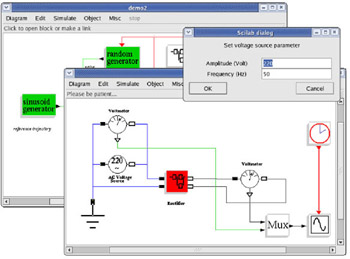
Scicos provides a modular way to construct complex dynamical systems using a block diagram editor. Scicos diagrams are compiled and simulated efficiently by a single click. Scicos handles, in particular, the interaction between continuous-time dynamics and system events including events associated with the timing of a discrete-time clock. Such events affect the way the numerical solver, which integrates the continuous-time dynamics, should be called. Handling efficiently such matters by hand for complex dynamical systems can be extremely difficult.
Using Scicos, the user can construct a library of reusable modules (blocks) that can be used in different models in different projects. This is particularly useful when a large model is composed of modules designed by different development teams. The Scicos formalism, which must be respected in designing blocks and submodels, guarantees that modules constructed separately and interconnected can...
Copyright Springer Science+Business Media, Inc. 2006 under license agreement with Books24x7

 TABLE OF CONTENTS