MRO Inventory and Purchasing: Maintenance Strategy Series, Volume 2
Most MRO storerooms also contain maintenance and repair tools. Typically, these tools are not assigned to any one technician, but are kept in a central location so that all technicians have access to them. This category also includes tools that are not used frequently. Therefore, there is little likelihood that the tools will be demanded at the same time. These tools are typically high dollar, expensive to repair, or replacements for lost or damaged tools.
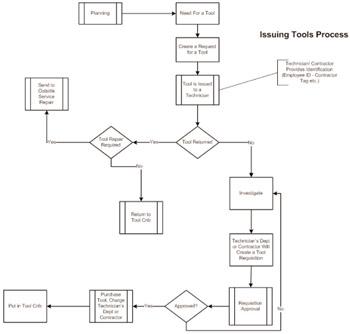
Figure 3-1 shows the typical process for controlling tools. A demand is usually issued from planning for a particular job, which is assigned a work order number. The plan typically will identify the tool that is required for the job. A request for the tool, usually generated electronically, is sent to the storeroom. Depending on the scheduling window, the tool may be set aside for the particular work. If the tool is not set aside, the storeroom is usually notified when the weekly schedule (pick list) is run, and the tool is staged with the spare parts for the same job.
When the tool is issued, it is typically issued to a technician, whose ID is placed on the work order. If the work is being performed by a contractor, then some identification from the contractor is typically left at the storeroom when the tool is issued. This is to ensure that the tool is properly tracked, whether it is issued to an internal technician or...