Multiantenna Wireless Communication Systems

6.4: SISO CHANNELS

6.4 SISO CHANNELS

The optimal coding and decoding matrices have been obtained using a completely general setting. The optimal solutions will be now particularized to specific operative conditions, in order to associate a physical meaning with the solutions found before.

6.4.1 Time-Invariant Channels

In case of SISO time-invariant channels, using block transmissions, with blocks of size N, and a CP of length at least equal to the channel order, the channel matrix assumes the structure of (3.17). Then, it admits an eigen-decomposition as in (3.18), with eigenvalues equal to the values of the channel transfer function. In case of white noise, we have

(6.90)

where H( k) = h( l) e - j 2 ?kl / N.

6.4.1.1 Optimal Transmit Power Spectral Densities

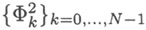
Equation (6.90) allows us to interpret the power allocation resulting from the optimization strategies studied before as a power distribution function of the discrete frequency k/ N. In the limit as the block length increases, the discrete power allocation tends to a function P( f) of the continuous variable f that assumes the meaning of a frequency. Hence, using (6.90), we can write the asymptotic (as the blocklength goes to infinity) power spectral density P( f) of the transmitted signals, according to different optimization criteria as follows.

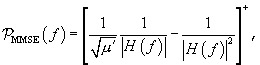
  1. MMSE with average power constraint

    From (6.49), we get

    (6.91)

    where [ x] + ? max( x, 0), and the coefficient ?

UNLIMITED FREE
ACCESS
TO THE WORLD'S BEST IDEAS

SUBMIT
Already a GlobalSpec user? Log in.

This is embarrasing...

An error occurred while processing the form. Please try again in a few minutes.

Customize Your GlobalSpec Experience

Category: Optical Interleavers
Finish!
Privacy Policy

This is embarrasing...

An error occurred while processing the form. Please try again in a few minutes.