Multivariate Statistical Methods in Quality Management

One of the most important issues in using factor analysis is its interpretation. Factor analysis often uses factor rotation to enhance its interpretation. Factor rotation can be expressed by the following:
| (5.57) | |
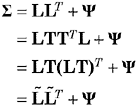
where T = T m m is called a rotation matrix. T is also an orthogonal matrix, that is, TT T = I. Therefore,
| (5.58) | |
So if we use
to replace L as the factor loading matrix, it will have the same ability to represent the correlation matrix ?.
After rotation
| (5.59) | |
where
is the new rotated factor loading matrix and
is the new rotated factor. The new factor
will also be a standard normal vector such that
This is because that if
will also be multivariate normal random variable,
due to the fact that T is an orthogonal matrix.
The purpose of rotation is to make the rotated factor loading matrix
have some desirable properties. There are two kinds of rotations. One is to rotate the factor loading matrix such that the rotated matrix
will have a simple structure. The other is called procrustes rotation, which is trying to rotate the factor matrix to a target matrix. We will discuss these two rotations in subsequent subsections.
Thurstone (1947) suggested the following criteria for simple structure:
Each row of
should contain at least one zero.
Each column...