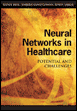
Neural Networks in Healthcare: Potential and Challenges
In the field of pattern recognition, probabilistic neural networks (PNNs) have been proven as an important classifier. For pattern recognition of EMG signals, the characteristics usually used are: (1) amplitude, (2) frequency, and (3) space. However, significant temporal characteristic exists in the transient and nonstationary EMG signals, which cannot be considered by traditional PNNs. In this article, a recurrent PNN, called recurrent loglinearized Gaussian mixture network (R-LLGMN), is introduced for EMG pattern recognition, with the emphasis on utilizing temporal characteristics. The structure of R-LLGMN is based on the algorithm of a hidden Markov model (HMM), which is a routinely used technique for modeling stochastic time series. Since R-LLGMN inherits advantages from both HMM and neural computation, it is expected to have higher representation ability and show better performance when dealing with time series like EMG signals. Experimental results show that R-LLGMN can achieve high discriminant accuracy in EMG pattern recognition.
Electromyographic (EMG) signals provide information about neuromuscular activities and have been recognized as efficient and promising resources for humanmachine interface (HMI) used for the rehabilitation of people with mobility limitations and those with severe neuromuscular impairment. Typically, a pattern recognition process is applied to translate EMG signals into control commands...