Nonlinear Vibrations and Stability of Shells and Plates

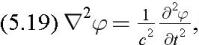
An inviscid, irrotational and compressible fluid coupled to a vibrating shell is considered (Morand and Ohayon 1992). The fluid is driven into oscillation by the shell and has no mean flow. The fluid can be internal or external to the shell and, in the longitudinal direction, is confined in the shell length. In the case of external fluid, this condition is equivalent to that of a shell of infinite length surrounded by fluid and infinite supports, each one at distance L from the next one; therefore, for external fluid, L is the shell length between two consecutive supports. The shell is completely filled in the case of internal fluid; in the case of external fluid, the fluid domain is assumed to be infinite in the radial direction. Therefore, the fluid does not present a free surface and sloshing is not present. The velocity potential ? of the fluid satisfies the Helmholtz equation
where the Laplacian operator
in cylindrical coordinates is given by
r, ?, x being the cylindrical coordinates and c the velocity of sound in the fluid. The velocity of the fluid at any point is related to ? by v= ?
?. No cavitation is assumed at the fluid-shell interface at r=R:
where the positive sign is on the right-hand side if the w is assumed positive inward. For a simply supported circular cylindrical shell,...