5.4 Rayleigh-Ritz Method for Linear Vibrations
The case of simply supported circular cylindrical shells is very special, because the closed-form analytical solution of mode shapes (5.5a c) is obtained. For different boundary conditions, or by complicating the system by attaching lumped masses or springs, a closed-form analytical solution cannot be obtained. In these cases, it is necessary to use an approximate method to discretize the system. For this purpose, a powerful tool is the Rayleigh-Ritz method.
The equation of motion for free harmonic vibrations of an undamped structure can be written in the following form:
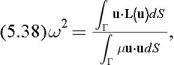
where L is a self-adjoint differential operator, u is the displacement vector of the middle surface (for plates and shells) of the structure, ? is the corresponding radian frequency and is the mass per unit length or area ( = ? for plates and shells). For the system considered, it is possible to write the Rayleigh quotient
? being the middle surface of the structure. The numerator on the right-hand side of equation (5.38) equals twice the maximum potential energy of the system
and the denominator is twice the reference kinetic energy, that is, the maximum kinetic energy divided by ? 2 of the system
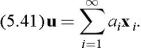
The Rayleigh-Ritz method is used to find natural frequencies and mode shapes. In particular, u is expanded by using a sum of admissible vectorial functions x i and appropriate unknown coefficients a i
The infinite sum in equation (5.41) is...


 TABLE OF CONTENTS