Numerical Analysis Using MATLAB and Excel, Third Edition
Appendix C: Ill-Conditioned Matrices

This appendix supplements Chapters 4 and 14 with concerns when the determinant of the coefficient matrix is small. We will introduce a reference against which the determinant can be measured to classify a matrix as a well- or ill-conditioned.

C.1 The Norm of a Matrix

A norm is a function which assigns a positive length or size to all vectors in a vector space, other than the zero vector. An example is the twodimensional Euclidean space denoted as R 2. The elements of the Euclidean vector space (e.g., (2,5)) are usually drawn as arrows in a two-dimensional cartesian coordinate system starting at the origin (0,0). The Euclidean norm assigns to each vector the length of its arrow.

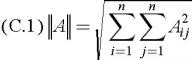
The Euclidean norm of a matrix A, denoted as A, is defined as


and it is computed with the MATLAB function norm(A).

Example C.1

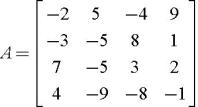
Using the MATLAB function norm(A), compute the Euclidean norm of the matrix A, defined as


Solution:

At the MATLAB command prompt, we enter

A=[2  5  ?4  9; ?3 ?6  8  1; 7  ?5  3  2; 4  ?9 ?8 ?1]; norm(A)

and MATLAB outputs

ans =   14.5539

C.2 Condition Number of a Matrix

The condition number of a matrix A is defined as


where A is the norm of the matrix A defined in relation (C.1) above. Matrices with condition number close to unity are said to be well- conditioned matrices

UNLIMITED FREE
ACCESS
TO THE WORLD'S BEST IDEAS

SUBMIT
Already a GlobalSpec user? Log in.

This is embarrasing...

An error occurred while processing the form. Please try again in a few minutes.

Customize Your GlobalSpec Experience

Category: Polarimeters
Finish!
Privacy Policy

This is embarrasing...

An error occurred while processing the form. Please try again in a few minutes.