Optical Communications Rules of Thumb
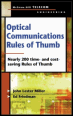
250 never-before-collected rules based on the authors' cumulative decades of experience in the field.
 TABLE OF CONTENTS
 While the fiber is widely used in telecom, the use of free-space optical communication is another promising communications architecture. Two applications are emerging. First, terrestrial communication for enterprise, "last mile," and "last meter" applications or for temporary applications. The second area that is getting attention is space. Space-to-space and space-to- ground applications are being explored to increase bandwidth, provide security, and reduce the size and mass of components in orbit. Interestingly, the space applications of optical communications derive much of their technology from components and methods developed for ground/ fiber systems. Fortunately for the space designer, the advances in lasers, amplifiers, and multiplexers can, in most cases, be adapted to space by providing a qualification path that yields parts of appropriately high reliability and radiation tolerance.
The terrestrial free-space communication designer has a unique set of challenges. A number of factors that control system performance are not within the designer's control, including the weather (and the associated humidity, turbulence, and smog along the communication path), laser power limitations imposed by eye safety issues, and so on. The best defense in these applications is a conservative design philosophy in which path length is limited to ranges where high-quality communication is nearly always possible and a networking strategy that allows easy expansion of the system along line-of-sight pathways. In addition, there will be areas of the world where reliable application of free-space communications cannot be expected due to frequent occurrences of fog and rain.
This chapter presents about a dozen ideas...