Optical Network Design and Planning

Oriented towards practical implementation, this guide takes a pragmatic approach to deploying state-of-the-art optical networking equipment in metro-core and backbone networks.
 TABLE OF CONTENTS
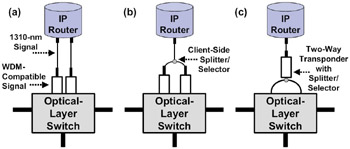
 Client-side and network-side protection refers to where the protection mechanism is triggered; i.e., at the clients at the endpoints (client side) or in the optical layer (network side). From a cost perspective, the main impact of the two schemes is the amount of equipment required at the endpoints of protected demands. Either type of protection can be operated in a dedicated or shared mode; however, for illustrative purposes, the discussion in this section will center around dedicated protection.
First, consider client-side 1+1 dedicated protection, where the client is responsible for generating two copies of the signal, both of which are transmitted over the optical layer. A demand endpoint with this type of protection is illustrated in Fig. 7.3(a), where an IP router is serving as the client. The router sends two copies of the signal to the optical layer, which routes them over disjoint paths. In the reverse direction, the router receives two copies of the signal and is responsible for selecting the better of the two copies.