Optical Network Design and Planning
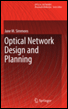
Oriented towards practical implementation, this guide takes a pragmatic approach to deploying state-of-the-art optical networking equipment in metro-core and backbone networks.
 TABLE OF CONTENTS
 As indicated by the discussion thus far in this chapter, there are numerous optical protection schemes that differ in aspects such as capacity efficiency, recovery speed, and coverage of various faults. Different network planning algorithms are needed to optimize the various schemes. This section addresses protection planning algorithms at a high level, to illustrate general techniques that may be used in the design process.
Section 3.6 of Chapter 3 covered routing algorithms that find link-and-nodedisjoint paths between a source and destination; i.e., Shortest Pair of Disjoint Paths (SPDP) algorithms. If completely disjoint paths are not possible, such algorithms can find the maximally disjoint set of paths. SPDP algorithms are at the heart of most protection design strategies.
Section 3.6 also covered the notion of Shared Risk Link Groups (SRLGs), where a single failure may cause multiple links to fail due to shared conduit. More generally, Shared Risk Groups (SRGs) refers to any set of network resources that are part of the same failure group. Diversity with respect to SRGs is desirable as part of protection planning. As described in Section 3.6, there are various graph transformations that can be used to handle the most common SRG configurations.
First, consider network planning with dedicated protection. Routing can be performed using the techniques of Chapter 3, where a SPDP algorithm is used to find a set of candidate working and protect paths that are link/node disjoint. As demand requests enter the network, one...