Organic and Inorganic Nanostructures

The technique of electrostatic self-assembly (ESA), also known as polyelectrolyte self-assembly or electrostatic layer-by-layer deposition, is based upon electrostatic interaction between polymers containing cation and anion groups. The method was developed at the beginning of the 1990s by G. Decher and colleagues [66 72], although historically this idea was suggested earlier [73, 74]. The ESA method became extremely popular, and within the following decade was adopted and further developed in many research laboratories [75 119].
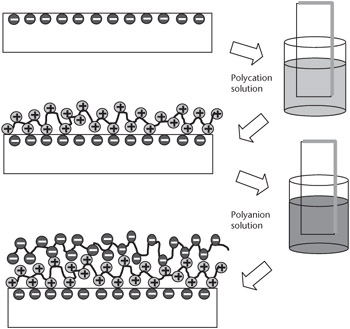
Multilayered polymer films can be deposited onto an electrically charged substrate by its sequential dipping in solutions of polycations and polyanions. This process is shown schematically in Figure 2.5. Starting from a negatively charged substrate, the first layer of polycations can be deposited by simply dipping the sample into a polycation solution. At this stage, positively charged ionic groups of the polymer interact electrostatically with the substrate, leaving a number of positive ions available for further binding. The next layer of polyanions can be transferred onto the substrate by dipping the sample into a polyanion solution. This deposition routine can be repeated many times, accompanied by the washing out of nonbound polyion molecules after each layer deposited.
A number of polycations and polyanions are presently commercially available, and the most common compounds...