Organic and Inorganic Nanostructures

Chapter 5: Electron Transport in Organic/Inorganic Nanostructures

5.1 Conductivity of Thin Films

The electrical conductivity of thin films made of either organic or inorganic materials was a subject of extensive study for decades, and the knowledge was summarized in a number of review papers and books [1 25]. The key points of both theoretical and experimental aspects of electrical conductivity of thin films are reviewed here, with the focus on quantum phenomena in conductivity, such as electron tunneling and single-electron processes, having great potential in the development of nano-electronic devices.

5.1.1 Definitions and Experimental Methods

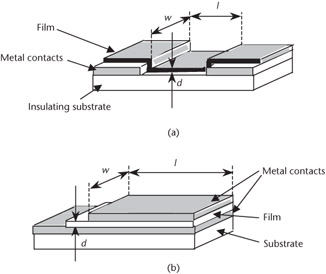
Electrical conductivity of thin films can be studied (both theoretically and experimentally) in two possible configurations: (1) conductivity in the film plane (i.e., lateral or planar conductivity), and (2) conductivity in the direction perpendicular to the film surface (i.e., normal conductivity). Experimentally, these two types of conductivity can be tested in the planar and sandwich structures, respectively, as shown in Figure 5.1.


Figure 5.1: The structure's conductivity measurements of thin films (a) planar structure, and (b) sandwich structure.

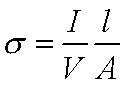
In both cases, the conductivity can be defined as:

(5.1)

where V is the voltage applied between two electrodes, separated by the distance l, which drives the current I through the cross-section A. The units for conductivity are [ ? -1m -1] or [Sm -1]. In the planar structures, L is the minimal distance between the electrodes, and A = d w is a product of a film thickness d and the electrode width

UNLIMITED FREE
ACCESS
TO THE WORLD'S BEST IDEAS

SUBMIT
Already a GlobalSpec user? Log in.

This is embarrasing...

An error occurred while processing the form. Please try again in a few minutes.

Customize Your GlobalSpec Experience

Category: Conductivity Electrodes
Finish!
Privacy Policy

This is embarrasing...

An error occurred while processing the form. Please try again in a few minutes.