Phased Array Antenna Handbook, Second Edition

Chapter 2: Pattern Characteristics of Linear and Planar Arrays

2.1 Array Analysis

2.1.1 The Radiation Integrals

As shown in many texts [1], the free-space electromagnetic field can be expressed in terms of integrals over elementary electric and magnetic current sources. The field due to an electric current density J in a volume is obtained from the vector potential integral A, where A is given by


for


and the associated electric and magnetic fields are given by


and ? = 2 ? f.

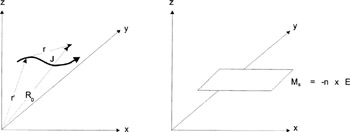
The segment of wire shown in Figure 2.1 indicates that the vector potential is routinely used to compute the radiation from wire antenna structures.


Figure 2.1: Radiation from electric and magnetic current sources

The field due to a volume density of magnetic current is obtained from a potential function termed the electric potential and given by


and the associated fields are


In classical radiation problems, the magnetic current is understood to be a mathematical artifice, not a realizable current. Its value in antenna analysis is that it is regularly used to represent radiation from apertures described in terms of their known electric fields. In the case of an aperture antenna, the magnetic current is identified with the tangential electric field at the radiating aperture using


for , the outward-directed normal at the aperture. The subscripts S refer to surface magnetic currents, and in this expression the volume integral has shrunk to a surface integral. The aperture in Figure 2.1 depicts this use of the magnetic current to represent surface...

UNLIMITED FREE
ACCESS
TO THE WORLD'S BEST IDEAS

SUBMIT
Already a GlobalSpec user? Log in.

This is embarrasing...

An error occurred while processing the form. Please try again in a few minutes.

Customize Your GlobalSpec Experience

Category: Magnetic Receivers
Finish!
Privacy Policy

This is embarrasing...

An error occurred while processing the form. Please try again in a few minutes.