Phased Array Antenna Handbook, Second Edition

An important class of applications for arrays requires them to conform to some shaped surface, often the surface of an aircraft, missile, or some other mobile platform. The conformality may be required for aerodynamic reasons or to reduce the antenna's radar cross section. Sometimes arrays are conformal to a stationary shaped surface in order to increase the angular sector served by a single array. Arrays required to provide 180 azimuth coverage may be conformal to a cylinder, depending on the elevation coverage required, while a spherical surface may be required for full hemispherical coverage.
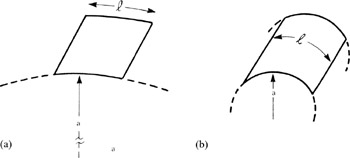
Arrays on nonplanar surfaces can be categorized according to the two sketches shown in Figure 4.1. If the array dimensions are small compared to the radius of curvature as in Figure 4.1(a), the array is treated as locally planar, with planar array elements summed in accordance with the geometry of the curved surface. Such nearly planar arrays also have coverage limited by the field of view of the planar array. Arrays that are large with respect to the radius of curvature [Figure 4.1(b)] conform to the surface and may be used to scan over a far larger sector if the illuminations are somehow commutated around on the surface. This commutation is accomplished by several means, which are discussed briefly in this chapter. For such large arrays, the analysis and synthesis are significantly more complex than for a nearly planar or a conventional planar array.