Photonic Devices
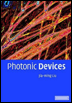
Assuming a basic knowledge of optics, semiconductors and electromagnetic waves, this unique text provides coverage of every major photonic device, and strikes a careful balance between theoretical and practical concepts.
 TABLE OF CONTENTS
 In many applications, it is necessary to control optical waves with externally applied signals to perform such functions as modulation, switching, deflection, isolation, frequency shifting, and polarization rotation of optical signals. Depending on the nature of the external control signal, these functions can be accomplished through the interactions of an optical wave with an electric field, a magnetic field, an acoustic wave, or another optical wave. Generally speaking, these interactions are all nonlinear optical phenomena. Nevertheless, electro-optic, magneto-optic, and acousto-optic effects each have very specific characteristics. Many useful devices have been developed based specifically on these effects for many important functions, such as optical modulation and optical switching. The electro-optic, magneto-optic, and acousto-optic devices are discussed separately in this and the following two chapters. The discussions in Chapter 9 then focus on nonlinear optical devices based solely on the interactions between optical waves.
The optical property of a dielectric material can be changed through an electro-optic effect in the presence of a static or low-frequency electric field E 0. The result is a field-dependent susceptibility and thus a field-dependent electric permittivity:
| (6.1) |  |
and
| (6.2) |  |
where field-independent ?( ?) = ?( ?, E 0 = 0) and ?( ?) = ?( ?, E 0 = 0) represent the intrinsic linear response of the material at the optical frequency ?, while ? ? and ? ? represent changes induced by the low-frequency field E 0