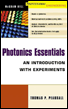
Photonics Essentials : An Introduction with Experiments
Chapter 7: Lasers

Overview

The word laser is an acronym for Light Amplification by Stimulated Emission of Radiation. Laser action is most commonly used to generate light. However, a laser can also be used to amplify light generated by an external source. An excellent example of this application is the erbium-doped fiber amplifier that is used in optical fiber communications to amplify light signals at 1550 nm. There is no battery hooked up to an erbium-doped fiber amplifier. It gets its power from an excitation light beam at one wavelength, and it uses this power to amplify light at another wavelength. Laser action is a general principal of the behavior of light absorption and emission by matter. As a result, lasing has been observed in a wide range of conditions and materials where luminescence is generated, including chemical reactions, antifreeze, gases, solids, liquids, and semiconductor p-n junctions. Even water can be made to support lasing in the far infrared. It is probably true that any material that can be made to emit light can also be made to lase under some conditions. It is thus not a surprise that these conditions are more easily achieved for some materials than for others. Semiconductor p-n junctions are among the materials in which we can achieve laser action most easily.

Semiconductor lasers cover a very wide range of optical wavelengths. Lasers can be built that span a range from less than 400 nm to more than 10,000 nm. No other materials...

UNLIMITED FREE
ACCESS
TO THE WORLD'S BEST IDEAS

SUBMIT
Already a GlobalSpec user? Log in.

This is embarrasing...

An error occurred while processing the form. Please try again in a few minutes.

Customize Your GlobalSpec Experience

Category: Fiber Optic Amplifiers
Finish!
Privacy Policy

This is embarrasing...

An error occurred while processing the form. Please try again in a few minutes.