Population Balances in Biomedical Engineering: Segregation Through the Distribution of Cell States

4.3: Fixed Control Points

4.3 Fixed Control Points

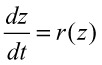
Looking back at the transient PBE, Eq. (4.1), it is clear that the characteristic curves are given by the differential equation


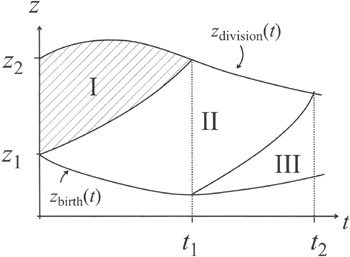
and the characteristic curves are therefore the single-cell growth curves. Keeping this in mind is helpful when solving the transient population balance. The process for doing so is sketched in Fig. 4.4. The solution is obtained in a repetitive process in which one first solves the PBE in an initial domain and then uses this solution together with the cell balances or boundary conditions to generate the initial conditions for a new domain [43].


Figure 4.4: Solution process for transient PBMs. The solution in the hatched domain, I, is found from the initial condition. This solution, in conjunction with the cell balance over division and birth, then provides an initial condition for the solution in domain II.

In Fig. 4.4, the region of state space in which cells are found is limited from below by the state of cells at birth, the curve z birth( t), and from above by the state of cells at division, the curve z division( t). It is possible to encounter more complex cases than the one depicted here, cases for which the state of cells at birth is not the lower bound on the cell containing region in state space. This will occur whenever the rate of single-cell growth is less than the rate of change of the state at birth. In such a situation,...

UNLIMITED FREE
ACCESS
TO THE WORLD'S BEST IDEAS

SUBMIT
Already a GlobalSpec user? Log in.

This is embarrasing...

An error occurred while processing the form. Please try again in a few minutes.

Customize Your GlobalSpec Experience

Category: Oxidation Reduction Potential (ORP) Electrodes
Finish!
Privacy Policy

This is embarrasing...

An error occurred while processing the form. Please try again in a few minutes.