Population Balances in Biomedical Engineering: Segregation Through the Distribution of Cell States

4.4: Transient Control Point Balances

4.4 Transient Control Point Balances

As already mentioned, the cell balances or boundary conditions that must be used in transient calculations are, in general, not the same as those that are used in steady-state calculations. Situations in which the birth and/or division state(s) change with time therefore present special problems. The reason for this is that the cell balances are obtained from expressions for the cell fluxes into and out of cell cycle control points and when the position of these points change with time, the fluxes depend on both the growth flux and the rate of change of the control point. The obvious solution to this is to set the flux of cells into the control point equal to the difference of the growth flux and the rate of change of the control point in other words, to use the growth rate relative to the control point velocity. This is correct in almost all cases. To determine exactly when it is correct, we derive this result more rigorously.

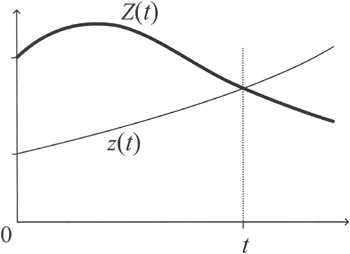
Consider the situation shown in a phase space plot in Fig. 4.6.


Figure 4.6: Calculation of cell flux into a moving control point. The growth curve of the cell, z( t), is indicated by the thin line; the trajectory of the control point, Z( t), is indicated by the thick line. The total number of cells that divide between time zero and time t is equal to the number of cells present at time zero with states

UNLIMITED FREE
ACCESS
TO THE WORLD'S BEST IDEAS

SUBMIT
Already a GlobalSpec user? Log in.

This is embarrasing...

An error occurred while processing the form. Please try again in a few minutes.

Customize Your GlobalSpec Experience

Category: Scales and Balances
Finish!
Privacy Policy

This is embarrasing...

An error occurred while processing the form. Please try again in a few minutes.