James F. Beall IV
Eastman Chemical Company, Longview, Texas
William L. Bialkowski
EnTech Control Engineering Inc., Toronto, Ontario, Canada
Jimmy G. Converse
Sterling Chemicals, Inc., Texas City, Texas
Mark T. Coughran
Fisher Controls International, Inc., Marshalltown, Iowa
John Edwards
Process NMR Associates, LLC (Foxboro), Danbury, CT 06810
Gregory Gervasio
Process Analytical Technology, Solutia Inc.,
St. Louis, Missouri
Tony Harding
Spectrace (Division of Thermo Instrument Systems),
Fort Collins, Colorado
J. B. Klahn
Applied Automation, Elsag-Bailey, Bartlesville, Oklahoma
K. K. Konrad
INTEK Corporation, Houston, Texas
Paul Luebbers
Solutia Inc., Cantonment, Florida
Gregory K. McMillan
Solutia Inc., St. Louis, Missouri
Michael J. Pelletier
Spectroscopy Products Group, Kaiser Optical Systems, Inc.,
Ann Arbor, Michigan
R. J. Proctor
GAMMA-METRICS, San Diego, California
Joseph P. Shunta, P. E.
E. I. du Port de Nemours, Wilmington, Delaware
Joseph Zente
Epsilon Industries, Austin, Texas
WORLD-CLASS MANUFACTURING
by Joseph P. Shunta, P. E. [*]
INTRODUCTION
Companies competing in a global market are constantly under pressure to reduce costs and improve quality. One of the ways to gain competitively is by increasing the productivity of manufacturing operations. This is an area to which process control can bring substantial benefits by improving quality of products, increasing yields, production rates, and uptime, and decreasing cycle time.
However, this does not happen automatically by simply installing the most modern control equipment as we experienced when distributed control systems became available in the 1980s. Many companies installed distributed control systems, expecting improved performance, only to find later that it was not significantly better than...
Copyright The McGraw-Hill Companies, Inc. 1999 under license agreement with Books24x7

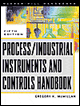
 TABLE OF CONTENTS