WHAT ARE CONSTRAINED MULTIVARIABLE PREDICTIVE CONTROL AND REAL-TIME OPTIMIZATION?
Discussions of process optimization often focus on the design of a process. A set of operating objectives are specified, including product throughputs, product specifications, and environmental restrictions. Given these objectives, the goal of process optimization is to determine the best arrangement and sizes of equipment to minimize both capital and operating costs.
For existing plants, which may or may not be operating at nameplate capacities, process optimization focuses on an entirely different problem: Given the fixed arrangement and sizes of equipment, the quality and cost of the feedstocks, utilities costs, product specifications, and market demand represented by the existing plant, what are the best operating conditions to produce the most valuable products at the lowest operating costs? This is the objective of real-time optimization (RTO).
The operating constraints of a chemical plant or refinery at any point in time may be a function of feed rate, production targets, ambient conditions, product specifications, or equipment performance. These items and the resulting constraints are all subject to change during normal operating conditions.
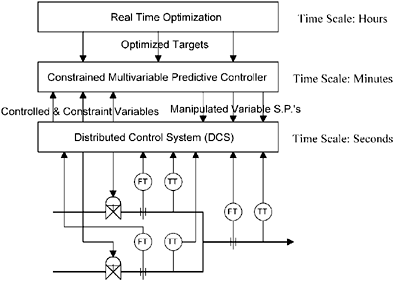 FIGURE 1: Hierarchy of RTO, CMPC, distributed control system and controlled process.
 The implementation of a RTO system requires a control system capable of consistently operating the process against these types of constraints. Constrained multivariable predictive control (CMPC) is a multivariable control algorithm that is able to meet these performance requirements.
In addition to operating the process against these...

 TABLE OF CONTENTS