Pump Handbook, Third Edition

2.2: CENTRIFUGAL PUMP CONSTRUCTION

2.2 CENTRIFUGAL PUMP CONSTRUCTION

2.2.1 CENTRIFUGAL PUMPS: MAJOR COMPONENTS

IGOR J. KARASSIK

C. C. HEALD

CLASSIFICATION AND NOMENCLATURE

A centrifugal pump consists of a set of rotating vanes enclosed within a housing or casing that is used to impart energy to a fluid through centrifugal force. Thus, stripped of all refinements, a centrifugal pump has two main parts: (1) a rotating element, including an impeller and a shaft, and (2) a stationary element made up of a casing, casing cover, and bearings.

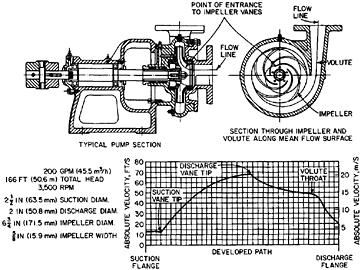
In a centrifugal pump, the liquid is forced by atmospheric or other pressure into a set of rotating vanes. These vanes constitute an impeller that discharges the liquid at its periphery at a higher velocity. This velocity is converted to pressure energy by means of a volute (see Figure 1) or by a set of stationary diffusion vanes (see Figure 2) surrounding the impeller periphery. Pumps with volute casings are generally called volute pumps, while those with diffusion vanes are called diffuser pumps. Diffuser pumps were once quite commonly called turbine pumps, but this term has become more selectively applied to the vertical deep-well centrifugal diffuser pumps usually referred to as vertical turbine pumps. Figure 1 shows the path of the liquid passing through an end-suction volute pump operating at rated capacity (the capacity at which best efficiency is obtained).


FIGURE 1: A typical single-stage, end-suction volute pump (Flowserve Corporation)

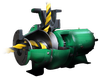
FIGURE 2: A typical diffuser-type pump

Impellers are classified according to...

UNLIMITED FREE
ACCESS
TO THE WORLD'S BEST IDEAS

SUBMIT
Already a GlobalSpec user? Log in.

This is embarrasing...

An error occurred while processing the form. Please try again in a few minutes.

Customize Your GlobalSpec Experience

Category: Centrifugal Pumps
Finish!
Privacy Policy

This is embarrasing...

An error occurred while processing the form. Please try again in a few minutes.