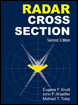
Radar Cross Section, Second Edition

Chapter 2: Radar Fundamentals

M.T.Tuley

2.1 INTRODUCTION

Although the study of radar cross section and its reduction are interesting from a purely academic point of view, we assume that the reader has a practical application in mind. That application is typically the prediction of a radar s performance against a given target, and then modification of the target RCS to reduce the performance of the radar.

The purpose of this chapter is to provide a brief survey of radar fundamentals that can be used to put the RCS and RCS reduction (RCSR) problems in context. Obviously, only some of the most basic points concerning radar can be covered in a single chapter, and the reader who seeks more detail can find it in any one of a number of books on the general topic of radar [1 5]. Here, after a brief history, radar system fundamentals are covered, with a focus on how radars discriminate in their measurement space of range, angle, and doppler. The radar range equation is developed, and its implication for RCSR is examined. Detection theory is then briefly discussed, and, finally, electronic countermeasure (ECM) techniques are outlined, with an emphasis on the effects of RCS control on ECM effectiveness.

2.2 HISTORY OF RADAR DEVELOPMENT

Radar did not come to the forefront as a useful sensor until World War II, when tremendous strides were made in both the theory and practice of radar technology. The earliest account of the reflection of radio frequency waves from metallic and dielectric bodies was...

UNLIMITED FREE
ACCESS
TO THE WORLD'S BEST IDEAS

SUBMIT
Already a GlobalSpec user? Log in.

This is embarrasing...

An error occurred while processing the form. Please try again in a few minutes.

Customize Your GlobalSpec Experience

Category: Weather Radar Systems
Finish!
Privacy Policy

This is embarrasing...

An error occurred while processing the form. Please try again in a few minutes.