Radar Cross Section, Second Edition

Eugene F.Knott
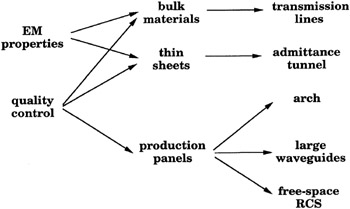
Like any other product, the design of a radar absorber depends a great deal on its intended application. The application itself, along with the properties of the materials available to fabricate the product, lead to the evolution of one or more concepts or configurations. Once we evolve a design to suit the application, whether specified or perceived, we must verify the performance of the concept. If we are successful enough to develop a product line from it, we must assure our customer of our widely advertised performance by means of quality control. These three different requirements demand three different kinds of measurement and evaluation, as diagrammed in Figure 9.1.
The most basic information needed in the electrical design of the absorber is the electromagnetic properties of the materials we expect to use to manufacture it. Equally basic, although not listed in the diagram, are the physical properties of those materials, such as density, tensile strength, durability, chemical stability, and compatibility with bonding systems (adhesives). Bulk materials are characterized by their relative permeabilities and permittivities, whereas thin sheets are more conveniently characterized by complex impedances. Permeability and permittivity are recognized as complex quantities, and we typically normalize these values with respect to the corresponding free-space values. The impedance of a thin sheet is also a complex quantity (a resistance and a reactance). Although the unit of sheet impedance is ohms, measured results are...