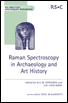
Raman Spectroscopy in Archaeology and Art History
The application of Raman spectroscopic techniques to the analysis of works of art in museums and the materials used in their creation received an initial impetus in the non-destructive characterisation of mineral pigments. [1], [2] Thereby, some novel physicochemical information was made available for the attribution of the historical period and genuineness of an artwork; in this context, it was often possible to arrive at conclusions about the operation of ancient technologies and methods used in the preparation of materials and in construction of the artwork. The appeal for museum conservators and art historians lay in the minimal disturbance to the artefact or artwork necessary for the scientific analysis and in the additional data provided from a micro-spectroscopic analytical approach. [3]
The most recent challenge for Raman spectroscopy working with archaeological specimens and in art work characterisation is provided by the non-destructive analysis of ancient biomaterials, covering an important and extremely wide range of specimens of very different chemical composition. [4] An idea of the diversity of biomaterials which have been analysed to date using Raman spectroscopy is provided in Table 16.1. Specifically, there are several advantages...