Rank-Deficient and Discrete Ill-Posed Problems: Numerical Aspects of Linear Inversion
6.7: Iterative Regularization Methods in Action

6.7 Iterative Regularization Methods in Action

As in the previous chapter, we conclude this chapter with numerical examples that illustrate the behavior of some of the iterative regularization methods, with special focus on regularizing CG iterations. The test problem used through out the examples is again shaw from 1.4.3, discretized with m = n = 64.

6.7.1 Error Histories

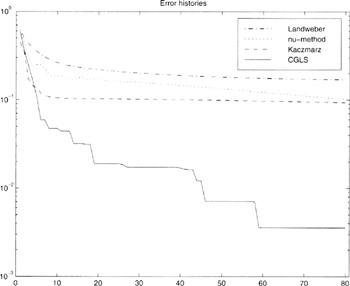
The error history for an iterative method with iterates x ( k) is a plot of the relative error norm ? x exact ? x ( k) ? 2/ ? x exact ? 2 versus the iteration number k. Figure 6.7 shows the error histories for classical Landweber iteration (6.2) with ? = 0.15, the v-method (6.7), Kaczmarz's method (6.10), and CGLS (6.14) applied to the shaw test problem with exact right-hand side. Notice the nonmonotonic behavior of the error for the v-method.


Figure 6.7: Error histories, i.e., ? x exact ? x ( k) ? 2/ ? x exact ? 2 versus k, for four iterative methods applied to the shaw test problem with exact right-hand side.

All four methods have an initial stage in which the convergence is faster than in the remaining iterations. In this initial stage, the solution's SVD components corresponding to the largest singular values are picked up. Overall, the first three methods converge much more slowly than CGLS, and the example clearly illustrates the potential power of regularizing...

UNLIMITED FREE
ACCESS
TO THE WORLD'S BEST IDEAS

SUBMIT
Already a GlobalSpec user? Log in.

This is embarrasing...

An error occurred while processing the form. Please try again in a few minutes.

Customize Your GlobalSpec Experience

Category: Diffractometers
Finish!
Privacy Policy

This is embarrasing...

An error occurred while processing the form. Please try again in a few minutes.