RF and Baseband Techniques for Software Defined Radio

In contrast with the area of transmitter design, where the requirement for linearity is a relatively recent phenomenon, receivers have needed to preserve signal amplitude information and, in particular, dynamic range in almost all designs over the years. Thus, most receivers, even those for FM and other constant-envelope systems, are inherently linear for the majority of their RF and IF paths. The translation from a conventional receiver design to a linear receiver design is therefore more straightforward than for an equivalent transmitter and may only involve alterations to the detection and (possibly) AGC stages.
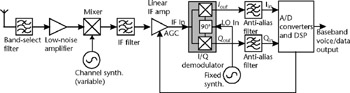
A simplified, single-band flexible receiver architecture is shown in Figure 3.1. Its flexibility stems from the use of a DSP as the baseband demodulation function; it can thereby demodulate any modulation format within its processing and data conversion bandwidth. Note that if a variety of different modulation formats are to be received by the same radio architecture, then the desired channel bandwidths must be carefully considered. For example, if the receiver is to handle both GSM (200-kHz bandwidth) and PDC (30-kHz bandwidth), then the IF filter, anti-alias filters, and A/D input bandwidth (and hence sampling rate) must be chosen based on the wider of the two bandwidths (more than 200 kHz for the IF filter and more than 100 kHz each for the anti-alias filters and A/D converter input bandwidths).
If this is done, then it is possible...