Roark's Formulas for Stress and Strain, Seventh Edition
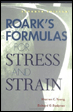
Chapter 8: Beams; Flexure of Straight Bars

8.1 Straight Beams (Common Case) Elastically Stressed

The formulas in this section are based on the following assumptions: (1) The beam is of homogeneous material that has the same modulus of elasticity in tension and compression. (2) The beam is straight or nearly so; if it is slightly curved, the curvature is in the plane of bending and the radius of curvature is at least 10 times the depth. (3) The cross section is uniform. (4) The beam has at least one longitudinal plane of symmetry. (5) All loads and reactions are perpendicular to the axis of the beam and lie in the same plane, which is a longitudinal plane of symmetry. (6) The beam is long in proportion to its depth, the span /depth ratio being 8 or more for metal beams of compact section, 15 or more for beams with relatively thin webs, and 24 or more for rectangular timber beams. (7) The beam is not disproportionately wide (see Sec. 8.11 for a discussion on the effect of beam width). (8) The maximum stress does not exceed the proportional limit.

Applied to any case for which these assumptions are not valid, the formulas given yield results that at best are approximate and that may be grossly in error; such cases are discussed in subsequent sections. The limitations stated here with respect to straightness and proportions of the beam correspond to a maximum error in calculated results of about 5%.

In the following discussion, it is assumed for...

UNLIMITED FREE
ACCESS
TO THE WORLD'S BEST IDEAS

SUBMIT
Already a GlobalSpec user? Log in.

This is embarrasing...

An error occurred while processing the form. Please try again in a few minutes.

Customize Your GlobalSpec Experience

Category: Electron Beam Processing Equipment
Finish!
Privacy Policy

This is embarrasing...

An error occurred while processing the form. Please try again in a few minutes.