Robotics: Appin Knowledge Solutions

On the CD Most robotic manipulators are strong rigid devices with powerful motors, strong gearing systems, and very accurate models of the dynamic response. For undemanding tasks it is possible to precompute and apply the forces needed to obtain a given velocity. This control is called computed torque control. Alternatively, a high-gain feedback on joint angle control leads to an adequate tracking performance. The important control problem is one of understanding and controlling the manipulator kinematics. Very few robots are regularly pushed to the limit where the dynamic model becomes important since this will lead to greatly reduce operational life and high maintenance costs. in this chapter we consider that part of the manipulator kinematics known as forward kinematics.
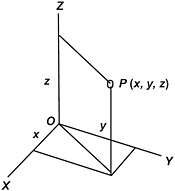
The manipulator hand s complete information can be specified by position and orientation. The position of a point can be represented in Cartesian space by a set of three orthogonal right-handed axes X, Y, Z, called principal axes, as shown in Figure 5.1. The origin of the principal axes is at O along with three unit vectors along these axes.
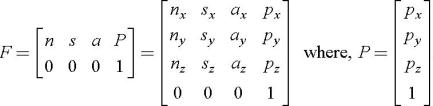
The position and orientation pair can be combined together and defined as an entity called frame, which is a set of four vectors, giving position and orientation information.
The above equation represents the general representation of a frame.