Satellite Systems Engineering in an IPv6 Environment

The model of the end-to-end performance of a theoretical (satellite) system is known as a "link budget." This chapter brings together many of the concepts defined in the first five chapters, and it shows how the designer can engineer a satellite link (or links) to meets specific business service goals. As we saw in Chapter 2, link budget is a generic term used to describe a series of mathematical calculations designed to model the performance of a communications link; there are many complex trade-offs involved in the design of a satellite link. A link budget is an identification and aggregation of the various system parameters of the satellite link according to pertinent engineering rules and is used to determine
The link performance from a fixed set of system parameters
Requisite system parameters given particular link performance criteria
In a typical simplex (one-way) satellite link there are two link budget calculations:
Link from the transmitting ground station to the satellite
Link from the spacecraft to the receiving ground station
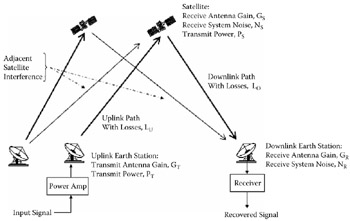
See Figure 6.1 for a reference model.
The satellite link contains transmit stations, receive stations, and the paths that connect them. The satellite is both a transmit station and a receive station. Many factors need to be included in the assessment of the end-to-end performance [USA199801]:
Link budget model
Uplink and downlink C/kT (carrier-to-receiver noise density)
Satellite receive power flux density
Positional data model
Earth terminal to satellite slant range