SFPE Handbook of Fire Protection Engineering

William D. Walton and Philip H.Thomas
Mr. William D. Walton is a research fire protection engineer with the Building and Fire Research Laboratory, National Institute of Standards and Technology.
Dr. Philip H. Thomas is retired from the Fire Research Station, Bore-hamwood, England.
The ability to predict temperatures developed in compartment fires is of great significance to the fire protection professional. There are many uses for a knowledge of compartment fire temperatures, including the prediction of (1) the onset of hazardous conditions, (2) property and structural damage, (3)changes in burning rate, (4)ignition of objects, and (5)the onset of flashover.
The fundamental principles underlying compartment fires are presented in Section 3, Chapter 5. This chapter gives a number of simplified solution techniques.
In this chapter, compartment fires are defined as fires in enclosed spaces, which are commonly thought of as rooms in buildings, but may include other spaces such as those found in transportation vehicles such as ships, planes, trains, and the like.
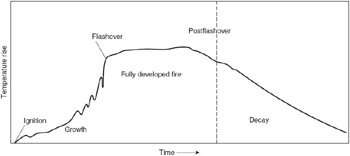
Compartment fires are often discussed in terms of growth stages. [1] Figure 3-6.1 shows an idealized variation of temperature with time along with the growth stages. The growth stages are
Ignition
Growth
Flashover
Fully developed fire
Decay
While many fires will not follow this idealization, it provides a useful framework for the discussion of compartment fires. All fires include an ignition stage but, beyond that, may fail to grow, or...