1.1 What is Correlation?
Correlation is a measure of the similarity, or relatedness, between two phenomena. When properly normalized, the correlation measure is a real number between 1 and +1, where a correlation value of +1 indicates that the two phenomena are identical, a correlation value of 1 means that they are diametrically opposite, and a correlation value of 0 means that they are uncorrelated, that is, that they agree exactly as much as they disagree.
In statistics, the correlation between two sets of data is called their covariance. In linear algebra, the correlation between two vectors is their (normalized) dot product. Specifically, let ? = ( a 1, a 2, , a n) and ? = ( b 1, b 2, , b n) be two n-dimensional vectors of real numbers, which could represent two sets of experimental data. The magnitudes of these vectors are 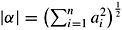 and
and 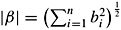 . The normalized vectors are
  and
and  . The correlation between the a i s and the b i s is the covariance of the two data sets
which is also the normalized dot product of the two vectors, that is, the dot product of the two vectors:
Geometrically, ( ? ?) = ? ? cos ?, so that
where ? is the angle between the vectors ? and ?. When the vectors are orthogonal (i.e., perpendicular), we have

 TABLE OF CONTENTS