Simulating the Physical World: Hierarchical Modeling from Quantum Mechanics to Fluid Dynamics

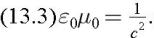
For convenience of the reader and for unity of notation we shall review the basic elements of electromagnetism, based on Maxwell s equations. We shall use SI units throughout. Two unit-related constants figure in the equations: the electric and magnetic permittivities of vacuum ? 0 and 0:
The basic law describes the Lorentz force F on a particle with charge q and velocity v in an electromagnetic field:
Here, E is the electric field and B the magnetic field acting on the particle. The fields obey the four Maxwell equations which are continuum equations in vacuum space that describe the relations between the fields and their source terms ? (charge density) and j (current density):
Moving charges (with velocity v) produce currents:
The charge density and current obey a conservation law, expressed as
which results from the fact that charge flowing out of a region goes at the expense of the charge density in that region.
In the presence of linearly polarizable matter with electric and magnetic susceptibilities ? e and ? m, an electric dipole density P and a magnetic dipole density ( M) are locally induced according to
The charge and current densities now contain terms due to the polarization:
where ? 0 and j 0 are the free or unbound sources. With the...