Simulating the Physical World: Hierarchical Modeling from Quantum Mechanics to Fluid Dynamics
A vector we know as an arrow in 3D-space with a direction and a length, and we can add any two vectors to produce a new vector in the same space. If we define three coordinate axes, not all in one plane, and define three basis vectors e 1 , e 2 , e 3 along these axes, then any vector v in 3D-space can be written as a linear combination of the basis vectors:
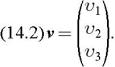
? 1 , ? 2 , ? 3 are the components of ? on the given basis set. These components form a specific representation of the vector, depending on the choice of basis vectors. The components are usually represented as a matrix of one column:
Note that the matrix v and the vector ? are different things: ? is an entity in space independent of any coordinate system we choose; v represents ? on a specific set of basis vectors. To stress this difference we use a different notation: italic bold for vectors and roman bold for their matrix representations.
Vectors and basis vectors need not be arrows in 3D-space. They can also represent other constructs for which it is meaningful to form linear combinations. For example, they could represent functions of one or more variables. Consider all possible real polynomials f( x) of the second degree, which can be written as
where a, b, c can be...