Smart Antenna Engineering

2.7: Coverage Versus Capacity Trade-Off

2.7 Coverage Versus Capacity Trade-Off

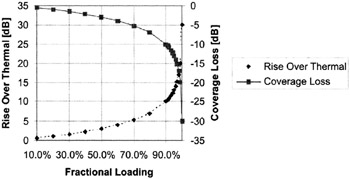
There is an inherit trade-off in CDMA between the capacity and coverage because of the way interference affects performance. On the uplink, interference increases as the load is increased and follows the expression of 1/(1 ?), where ? is fractional loading defined as N/N pole. Figure 2.25 shows how the interference rises over thermal noise as the fractional loading increases. To reach the pole capacity, the power that the mobiles are required to transmit goes to infinity to overcome this interference. As the required power increases, mobiles at the edge of coverage will begin to run out of transmitter power. That is, they will be asked to transmit more than their capability allows. It then follows that the system load should be controlled so that the planned service area never experiences coverage failures because of this phenomenon. This trade-off is not so much a problem or a limitation of CDMA systems as it is a system design consideration, which implies that maximum capacity and maximum coverage cannot be simultaneously achieved.


Figure 2.25: CDMA cell breathing.

2.7.1 Coverage-Capacity Trade-Off in the Uplink

Simple capacity models of the reverse link show that RF power rises with loading to overcome interference, as previously discussed. Real systems must operate below the pole capacity because real user stations have an upper bound to their transmitter power. As the load is increased, the average interference level also increases. Because mobile stations are transmitting at their maximum power,...

UNLIMITED FREE
ACCESS
TO THE WORLD'S BEST IDEAS

SUBMIT
Already a GlobalSpec user? Log in.

This is embarrasing...

An error occurred while processing the form. Please try again in a few minutes.

Customize Your GlobalSpec Experience

Category: X-ray Sources
Finish!
Privacy Policy

This is embarrasing...

An error occurred while processing the form. Please try again in a few minutes.