Smart Mems and Sensor Systems

2.2: Passive Components

2.2 Passive Components

2.2.1 Introduction to Passive Components and Their Fabrication

Passive MEMS devices are those components whose principal aim is neither actuation nor sensing, but which respond passively to their environment.

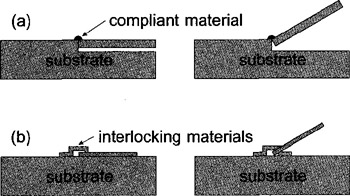
An example of such a passive device is a simple MEMS hinge that allows two planes of material to be moved relative to each other about a common line. This either requires the two planes to be glued to each other using a compliant material as the hinge [8], or for the two planes to be physically interlocked [9], as illustrated in Figure 2.5. In either case, an externally applied force is required to cause the hinge to move. Surface tension has been shown to provide a suitable force for the self-assembly of simple three-dimensional microstructures with hinged components [10].


Figure 2.5: A passive MEMS hinge can be created by (a) using a compliant material or (b) interlocking materials

More complicated mechanical passive components include MEMS linkages and gears [11]. Once more, these components do not actually generate any motion in their own right, but instead can be used to mechanically transfer motion from an actuator to an object that needs to be moved. Such a system can also transform the direction in which a force is applied from that in which it is generated, as well as changing the force-displacement characteristics to match those required to drive the load.

Passive mechanical MEMS components allow flat structures that are easily fabricated in the plane of a surface...

UNLIMITED FREE
ACCESS
TO THE WORLD'S BEST IDEAS

SUBMIT
Already a GlobalSpec user? Log in.

This is embarrasing...

An error occurred while processing the form. Please try again in a few minutes.

Customize Your GlobalSpec Experience

Category: MEMS Devices
Finish!
Privacy Policy

This is embarrasing...

An error occurred while processing the form. Please try again in a few minutes.