Solar Power in Building Design: The Engineer's Complete Design Resource

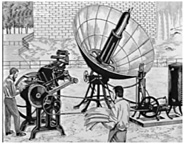
In this chapter we will review the basic principles of passive solar energy and applications. The term passive implies that solar power energy is harvested with direct exposure of fluids such as water or a fluid medium that absorbs the heat energy. Subsequently the harvested energy is converted to steam or vapor which in turn is used to drive turbines or provide evaporation energy in refrigerating and cooling equipment. Figure 10.1 depicts historical use of passive solar energy to power a printing press.
Solar power is the sun s energy without which life as we know it on our planet would cease to exist. Solar energy has been known and used by humankind throughout ages. As we all know, solar rays concentrated by a magnifying glass can provide intense heat energy that can burn wood or heat water to a boiling point. As discussed later, recent technological developments of this simple principle are currently being used to harness the solar energy and provide an abundance of electric power. Historically the principle of heating water to a boiling point was well-known by the French who in 1888 used solar power to drive printing machinery.
Please refer to Appendix D for a detailed solar power historical time line.
The simplest method of harvesting energy is exposing fluid-filled pipes to sun rays. Modern technology passive solar panels that heat water for pools and general household...